
Fender Stratocaster Setup PDF: A Comprehensive Guide
This guide consolidates online Fender instructions and resources like Sweetwater, offering a detailed PDF for optimal Stratocaster performance. It covers all essential adjustments!
A Stratocaster setup is crucial for maximizing playability and unlocking the instrument’s full tonal potential. This process involves precise adjustments to various components, ensuring optimal performance tailored to individual playing styles. Fender provides official guides, and numerous online tutorials detail each step.
Proper setup addresses neck relief, string action, intonation, pickup height, and bridge balance. Ignoring these elements can lead to buzzing, tuning instability, and compromised sound quality. This comprehensive guide, drawing from resources like Sweetwater and Fender’s documentation, aims to empower you to confidently perform these adjustments yourself.
Understanding the Importance of a Proper Setup
A correctly setup Stratocaster dramatically enhances playability, reducing fatigue and improving technique. Buzzing strings, high action, and intonation issues hinder performance and enjoyment. A precise setup ensures accurate intonation across the fretboard, vital for harmonic clarity.
Optimized pickup heights unlock the instrument’s tonal range, delivering a balanced and responsive sound. Fender emphasizes the impact of these adjustments. Ignoring setup leads to a frustrating playing experience; a well-executed setup transforms your Stratocaster into a finely-tuned instrument.
Tools Required for a Stratocaster Setup
Essential tools include screwdrivers, Allen wrenches, a feeler gauge, a tuner, and string cutters for a successful Stratocaster setup, as detailed in Fender guides.
Essential Tools List
For a comprehensive Stratocaster setup, gather these necessities. You’ll need a set of screwdrivers – both Phillips and flathead – to adjust pickups and hardware. Allen wrenches, typically metric, are crucial for truss rod and saddle adjustments. A precision tuner ensures accurate pitch. String cutters facilitate clean string changes.
A feeler gauge is vital for measuring neck relief and action height. A ruler with millimeter markings aids in precise measurements. Don’t forget a soft cloth to protect the finish, and potentially a neck rest for stability during work. These tools, referenced in Fender setup guides, are fundamental.
Optional but Helpful Tools
While not strictly required, several tools enhance a Stratocaster setup. A digital caliper provides extremely accurate measurements for string height and nut slots. A string action gauge simplifies action assessment. A fret rocker helps identify high frets needing attention.
A notched straightedge assists in precise neck relief adjustments. A pickup height meter offers consistent pickup height readings. Lubricant, like graphite, reduces friction at the nut. These additions, often discussed in online tutorials, streamline the process and improve precision, complementing Fender’s recommendations.
Neck Relief Adjustment
Adjusting the truss rod controls neck bow, crucial for playability. Incremental turns—1/8th to 1/4—are recommended, checking relief after each adjustment for optimal results.
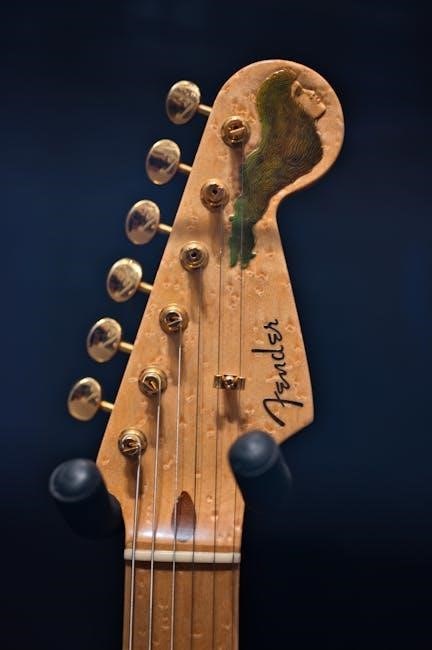
Truss Rod Adjustment Explained
The truss rod, inside the neck, counteracts string tension. Tightening (clockwise) reduces neck bow, while loosening (counter-clockwise) increases it. Adjustments are made to achieve proper “relief”—a slight forward curve.
Too much relief causes buzzing, while too little results in fret rattle. Small adjustments are key; avoid drastic changes. Observe the neck carefully after each 1/8th to 1/4 turn. Patience is vital, as adjustments take time to settle. Remember to retune after each adjustment!
Measuring Neck Relief
To measure relief, capo the first fret. Depress the low E string at the neck-body joint. Using a feeler gauge, check the gap between the bottom of the string and the top of the 7th fret.
A typical gap is around 0.010” (0.25mm), but preferences vary. Insufficient relief shows little to no gap, while excessive relief reveals a larger space. Accurate measurement is crucial for effective truss rod adjustments and optimal playability.
Adjusting Truss Rod – Incremental Turns
Adjust the truss rod in small increments – 1/8th to 1/4 turns at a time. Tightening (clockwise) reduces relief, straightening the neck, while loosening (counter-clockwise) increases it, creating more bow.
After each adjustment, retune the guitar and re-measure neck relief. Allow time for the neck to settle before making further changes. Avoid over-tightening, which can damage the truss rod or neck. Patience is key for a successful setup!

String Action Adjustment
Adjusting string action involves modifying saddle height to achieve comfortable playability and minimize buzzing. Precise measurements are crucial for optimal results!
Measuring String Action
Accurate string action measurement is fundamental for a proper setup. Use a precision ruler to measure the distance between the bottom of the string and the top of the 12th fret. Ensure the guitar is in playing position during measurement.
This measurement should be taken while depressing the string at the first fret. Consistent measurements across all strings are vital. Remember to measure both the high and low E strings, as action often varies. This provides a baseline for subsequent saddle height adjustments.
Adjusting Saddle Height
Saddle height adjustment directly impacts string action and playability. Use a small Allen wrench to carefully raise or lower each saddle individually. Turning the saddle screw clockwise lowers the action, while counter-clockwise raises it.
Make incremental adjustments, checking the action after each turn. Aim for consistent action across all strings. Be mindful of intonation; significant action changes may necessitate intonation adjustments afterward. Prioritize comfort and playing style when setting the ideal height.
Standard String Action Heights
Typical string action measurements, using a ruler from the top of the 14th fret to the bottom of the string, serve as a starting point. For the low E string, aim for 6/64” (2.4mm), and for the high E string, 4/64” (1.6mm).
These are merely guidelines; personal preference is crucial. Lower action facilitates faster playing, but may cause buzzing. Higher action provides clearer tone but requires more finger pressure. Adjust to find your sweet spot!
Intonation Setup
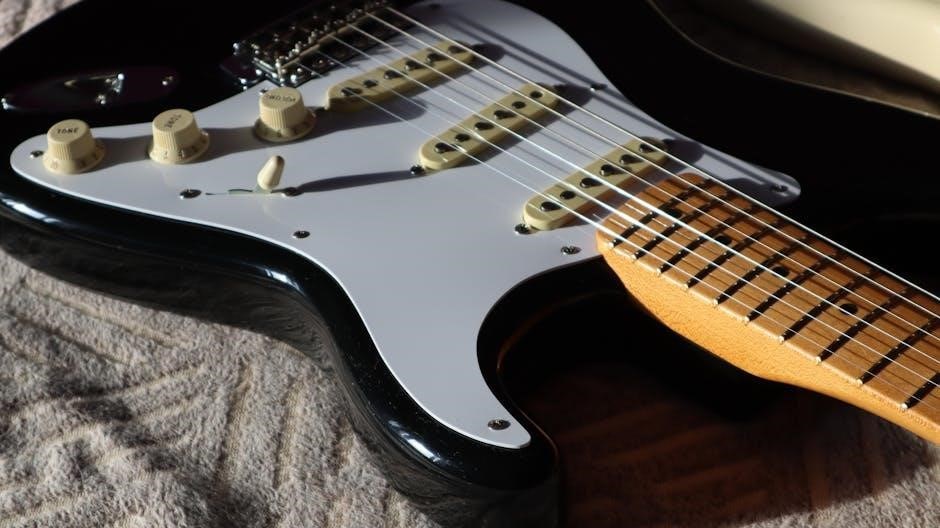
Proper intonation ensures notes played on the fretboard match the harmonic at the 12th fret, guaranteeing accurate pitch across the Stratocaster neck.
What is Intonation?
Intonation refers to the accuracy of a guitar’s pitch as you move up the neck. Ideally, a fretted note should match the pitch of its harmonic counterpart at the 12th fret. When intonation is off, chords sound dissonant, and single notes are out of tune higher up the fretboard.
Essentially, it’s about compensating for string thickness and tension. The scale length is consistent, but thicker strings require more length to reach the same pitch when fretted. Adjusting the saddle position fine-tunes this compensation, ensuring consistent tuning across all frets, resulting in a harmonically pleasing sound.
Checking Intonation at the 12th Fret
To check intonation, begin by playing the harmonic at the 12th fret of each string – lightly touch the string directly over the 12th fret and pluck. Then, fret the same string at the 12th fret. Compare the harmonic pitch to the fretted note.
If the fretted note is sharp, lengthen the string by moving the saddle back. If it’s flat, shorten the string by moving the saddle forward. Repeat this process for each string, ensuring accurate pitch across the entire fretboard for optimal playability.
Adjusting Saddle Position for Intonation
Adjusting the saddles involves loosening the saddle height screw and then using a small screwdriver to move the saddle forward or backward. Remember, moving the saddle away from the neck lengthens the string, flattening the pitch at the 12th fret.
Conversely, moving it towards the neck shortens the string, sharpening the pitch. Make small adjustments, re-check the harmonic and fretted note, and repeat until both match perfectly on each string.
Pickup Height Adjustment
Pickup height significantly impacts tone and output. Adjusting these heights allows for optimal sound, balancing volume between pickups and minimizing string pull.
Impact of Pickup Height on Tone
Pickup height dramatically influences your Stratocaster’s tonal characteristics. Closer to the strings yields a hotter, more powerful sound with increased output, but can introduce unwanted string pull and potential for muddiness. Conversely, lowering the pickups results in a cleaner, more articulate tone with reduced output.
Finding the sweet spot involves balancing these factors. Higher pickups emphasize harmonics and sustain, while lower settings provide clarity and dynamic range. Experimentation is key, as ideal height depends on your playing style, strings, and desired sound. Adjustments affect both volume and tonal color.
Recommended Pickup Heights (Neck, Middle, Bridge)
As a starting point, Fender suggests approximately 2.4mm (bass side) and 2.0mm (treble side) for the neck and middle pickups. The bridge pickup typically sits slightly lower, around 2.0mm (bass) and 1.6mm (treble).

These are merely guidelines; optimal heights are subjective and depend on your individual preferences and playing style. Adjust incrementally, listening carefully for changes in tone and output. Remember to re-evaluate after making adjustments to other components like string action or intonation for a balanced sound.
Adjusting Pickup Height for Optimal Sound
Fine-tuning pickup height dramatically impacts your Stratocaster’s tone. Lowering pickups generally reduces output and brightens the sound, while raising them increases output and adds warmth.
Experiment by making small adjustments – 1/16th of an inch at a time – and listen critically for changes. Pay attention to balance between pickups, aiming for consistent volume levels. Consider your playing style; aggressive players may prefer higher pickups for increased sustain and output.
Bridge Height and Spring Tension
Maintaining balance between bridge height (around 1/8 inch gap) and spring tension is crucial for tuning stability and optimal Stratocaster performance, as Fender recommends.
Optimal Bridge Height (Gap between Strings and Body)
Achieving the correct bridge height is vital for playability and tone. Fender officially recommends a gap of approximately 1/8 inch (3.2 mm) between the bottom of the guitar strings and the body of the instrument. This measurement provides sufficient space for string vibration without causing unwanted buzzing or damping.
However, personal preference plays a significant role. Some players prefer a slightly higher action for a bolder sound, while others opt for a lower action for easier bending. Regularly checking and adjusting this gap ensures optimal performance and responsiveness from your Stratocaster.
Adjusting Spring Tension
Balancing spring tension is crucial when modifying bridge height. Located in the tremolo cavity, the springs counteract string tension. To increase bridge height, tighten the spring claw screws, adding tension; Conversely, loosening the screws lowers the bridge.
Adjust incrementally, observing the bridge’s movement after each small turn. The goal is to achieve a stable “float” where the bridge remains parallel to the body. Proper spring tension ensures tuning stability and smooth tremolo operation on your Stratocaster.
Balancing Bridge Height and Spring Tension
Achieving harmony between bridge height and spring tension is vital for a responsive tremolo system. Fender recommends a 1/8” (3.2mm) gap between the strings and body. Adjust spring tension to maintain this height while ensuring the bridge doesn’t lift excessively or press flat.
Incremental adjustments are key; tighten or loosen spring claw screws slightly, re-tuning after each change. A balanced setup provides optimal sustain, intonation, and comfortable playing feel on your Stratocaster.

String Stretching and Tuning Stability
Proper stretching of new strings is crucial for tuning stability. Gently pull up on each string, re-tune, and repeat until tuning holds consistently.
The Importance of Stretching New Strings
New strings exhibit elasticity and will continually stretch during initial use, causing frequent tuning adjustments. Stretching them proactively minimizes this issue, leading to significantly improved tuning stability. The process involves gently pulling each string upwards along its length, typically at the first fret, while observing the tuner.
Hooking your fingers under the string and gently pulling upwards simulates playing tension. Retune after each stretch, repeating until minimal pitch change occurs. This pre-stretching ensures the strings settle, providing a more consistent and enjoyable playing experience, and reducing frustration during practice or performance.
Proper String Stretching Technique
Begin by tuning the string to pitch. Then, at the first fret, firmly grip the string and gently pull it upwards, away from the fretboard. Repeat this several times, increasing the pull slightly with each iteration. Next, move to the middle of the string and repeat the pulling process.
Finally, stretch the string near the bridge. After each stretch, retune the string. Continue this cycle until the string holds its tune with minimal slippage. This ensures even tension distribution, maximizing tuning stability and preventing premature breakage.
Maintaining Tuning Stability

Consistent tuning relies on several factors. After stretching new strings, ensure the nut slots are properly lubricated to minimize friction. Regularly check and tighten all tuning machine heads, eliminating any play. A properly returned string during winding on the tuning post is crucial;
Temperature and humidity fluctuations impact stability; consider a humidifier. Finally, avoid abrupt string bends until the strings are fully settled. Consistent practice and careful attention to detail will yield lasting tuning accuracy.
Checking and Adjusting Nut Height
Assess nut slot height by capo-ing the first fret and checking string clearance at the neck/body joint with a feeler gauge.
Assessing Nut Slot Height
Proper nut height is crucial for comfortable playing and avoiding issues like buzzing or intonation problems. Begin by capo-ing the guitar at the first fret. Then, depress each string at the fret where the neck joins the body.
Using a feeler gauge, carefully measure the distance between the bottom of the string and the top of the first fret. This measurement indicates the nut slot height. Too low, and you’ll get buzzing; too high, and playing will be difficult. Accurate assessment is key for a successful setup.
Nut Height Adjustment Considerations
Adjusting nut height is best left to experienced technicians, as it involves filing the nut slots. Incorrect filing can permanently damage the instrument. If slots are too low, they can be shimmed with thin material.
For higher slots, careful filing is required, always working slowly and checking frequently. Consider the string gauge; heavier strings require slightly higher slots. Professional help is recommended if you’re uncomfortable with this delicate process, ensuring optimal playability and avoiding costly mistakes.

Final Checks and Refinements

Assess overall playability, checking for buzzing or uncomfortable action. Fine-tune adjustments to string height, intonation, and pickup balance for a personalized feel.
Overall Playability Assessment
After completing adjustments, thoroughly evaluate the Stratocaster’s playability across the entire neck. Check for any fret buzz, particularly during bends, and identify areas needing further attention. Assess string action comfort – is it easy to fret notes without excessive pressure?
Evaluate how smoothly you can transition between chords and execute lead lines. Pay attention to tuning stability while playing dynamically. A well-setup guitar should feel responsive and inspire confident playing. Address any remaining issues before considering the setup complete.
Fine-Tuning Adjustments
Once the initial setup is done, subtle tweaks can significantly enhance playability. Address any lingering fret buzz with minor truss rod adjustments – small, incremental turns are key. Refine saddle height for optimal string action, balancing comfort and clarity.
Revisit intonation, ensuring accurate pitch across the fretboard. Experiment with pickup heights to sculpt your desired tone, finding the sweet spot between output and clarity. These final touches personalize the setup to your playing style.

Resources and Further Learning
Explore official Fender setup guides and online tutorials for deeper understanding. Downloadable PDF guides and videos offer comprehensive support for your Stratocaster!
Fender Official Setup Guides (PDF Links)
Fender provides valuable resources directly from their official channels to assist with your Stratocaster setup. While a single, comprehensive PDF isn’t readily available as a direct download, numerous guides and specifications are scattered across their support website. These resources detail recommended string gauges, action heights, and intonation procedures.
Players can find detailed information regarding bridge height adjustments, truss rod considerations, and pickup height settings. These guides often align with the factory specifications for various Stratocaster models. Searching “Fender guitar setup guide” will yield relevant links to their support pages, offering a wealth of knowledge for achieving optimal playability. Remember to consult multiple sources for a well-rounded understanding.
Online Setup Tutorials and Videos
YouTube is a treasure trove of Stratocaster setup tutorials, offering visual guidance alongside written guides. Many experienced luthiers and guitar technicians share their expertise through detailed videos, demonstrating each step of the process. A 1996 American Standard Strat setup video is a great starting point.
These resources cover everything from truss rod adjustments to intonation and pickup height. Platforms like Sweetwater also provide excellent instructional content. Visual learners will benefit greatly from these demonstrations, allowing them to see the techniques in action and replicate them effectively.
Recommended Setup Guides PDF Download
Fender provides official setup guides in PDF format, detailing specifications for your Stratocaster, including standard string gauges and action heights. These guides are invaluable for understanding factory settings and achieving optimal playability.
Furthermore, numerous guitar technicians and websites compile comprehensive setup guides available for download. A free guitar guide PDF packed with chords, scales, and setup information can supplement the official Fender documentation. These resources offer a consolidated reference for all your setup needs, ensuring a well-adjusted instrument.